Full Moon Haunted House Halloween 20oz
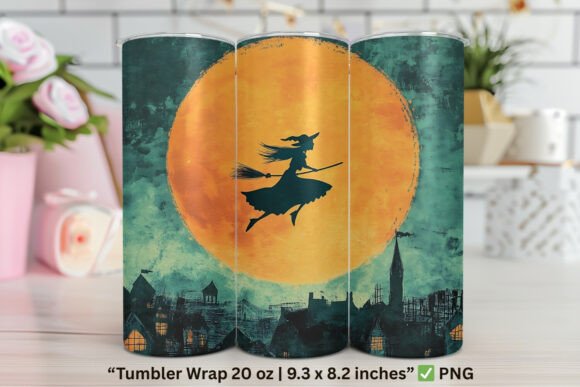
When I first opened the Full Moon Haunted House Halloween 20oz design, I was immediately struck by its compositional balance. The artwork presents a classic haunted house silhouette beneath a glowing full moon, with enough detail to feel rich but not so much that it becomes cluttered. As someone who regularly reviews design assets for embroidery adaptation, I know that what works well in a sublimation wrap does not always translate directly into thread. But this particular design has a lot of potential for those willing to adapt it thoughtfully.
A Design That Reads Like a Halloween Story
The mood here is unmistakably Halloween, but it avoids the overly cartoonish or gimmicky tone that can cheapen a finished product. The haunted house stands tall and angular, with broken rooflines, a few suggestive windows, and a silhouette that invites the eye to linger. The full moon behind it provides a natural focal point and creates strong contrast. In embroidery, that kind of contrast is gold. It gives you room to play with thread colors and lighting effects without losing the shape.
The layout is well proportioned for a vertical or slightly rectangular format, which makes sense given its origin as a tumbler wrap. The dimensions of 9.3 x 8.2 inches at 300 DPI give you a clean, high-resolution reference. But remember, this is a PNG file, not a vector. That means scaling up for larger embroidery projects could introduce pixelation if you are not careful. I recommend using it as a visual guide for creating your own digitized embroidery file, rather than attempting to convert the raster image directly. As a Graphics product in the Tumbler Wraps category, it is built for sublimation, but its visual strengths make it a strong candidate for embroidery adaptation.
Adapting the Artwork for Embroidery: What Holds Up and What Needs Care
When I evaluate a design like this for embroidery, I look at three things: clarity of shapes, density of details, and how the negative space works. The Full Moon Haunted House Halloween 20oz scores well on all three. The house silhouette is bold enough to be rendered with satin stitches or fill stitches, and the moon offers a natural area for a lighter thread color or even a subtle gradient effect if your machine supports it.
The tree branches and architectural details around the house are where you need to be careful. Fine elements like window frames, chimney lines, and jagged rooflines can become muddy if stitched too small. I would not attempt to replicate every single detail at a reduced size. Instead, simplify the linework for embroidery. Keep the essential silhouette of the house and the moon, and use running stitches or satin stitches for the key accents. The design will still read as a haunted house under a full moon without every tiny window being stitched.
Because the original is a PNG, you cannot extract clean vector paths. That means you will need to manually trace or digitize the design in your embroidery software. This is not a drawback if you are comfortable with digitizing, but it is worth noting for anyone who prefers working with SVG or DST files out of the box. The Full Moon Haunted House Halloween 20oz is best treated as a creative reference, not a ready-to-stitch embroidery file.
Real Project Scenarios: Where This Design Finds Its Natural Home
I recently prepared a custom embroidered tote bag for a Halloween craft fair, and I used this design as the starting point. I scaled it down slightly to fit a 6x10 inch hoop, simplified the tree branches, and stitched the moon in a pale yellow satin stitch with the house in a deep charcoal fill stitch. The result was clean, readable, and attracted a lot of attention at the booth. Customers specifically mentioned the full moon as the element that drew them in.
This design also works beautifully on sweatshirts. The high contrast between the moon and the house makes it readable from a distance, which is important for custom apparel that people wear in social settings. I have seen similar designs used on baby bibs and onesies, but I would be cautious there. The haunted house theme is clearly Halloween-oriented, and while some parents love spooky baby gear, others prefer softer imagery. Know your audience.
For personalized gifts, the Full Moon Haunted House Halloween 20oz adapts well to items like pillow covers, kitchen towels, and embroidered patches. The patch format is especially forgiving because you can control the fabric and stabilizer precisely. I have also used it as a reference for a cap embroidery project, though the curved surface of a cap requires significant simplification of the design. On a flat surface like a tote bag or a sweatshirt front, the design holds its shape much better.
Small shop owners and Etsy sellers will appreciate that this design reads as premium. It does not look like a generic clip art silhouette. The composition feels intentional, and that translates into a finished product that customers perceive as higher quality. Whether you are creating a one-off personalized gift or a small batch of boutique merchandise, the design gives you a strong foundation. For craft business owners, it also works well as a flagship item for seasonal holiday embroidery offerings.
Stitching Considerations: Where to Proceed with Caution
No design is perfect for every project, and Full Moon Haunted House Halloween 20oz has a few areas that demand attention. The first is stitch density. If you digitize the house with too many fill stitches, the design can become heavy and stiff, especially on lightweight fabrics. I recommend using a medium fill density and testing on a scrap piece of the same fabric before committing to the final product.
Small hoop sizes are another challenge. If you are working with a 4x4 hoop, you will need to scale the design down significantly, and that is where the fine details start to disappear. I would not attempt to stitch the full composition in a hoop smaller than 5x7 inches. If you only have a 4x4 hoop, consider stitching just the moon and a simplified house silhouette, leaving out the smaller architectural details.
Fabric texture also matters. On smooth fabrics like cotton or linen, the satin stitches on the moon will look crisp and clean. On textured fabrics like fleece or sweater knits, the same stitches can sink into the fabric and lose definition. Use a stabilizer that matches the fabric weight, and consider adding a layer of cutaway stabilizer for stretchy knits. Dark fabrics are a natural fit for this design because the moon provides strong contrast. If you stitch on light fabric, you may need to outline the moon with a dark running stitch to keep it visible.
Curved surfaces like caps and the sides of tote bags require extra attention. The design was originally made for a tumbler wrap, which is a cylindrical surface. That means the layout has a natural curve to it. When you adapt it to a flat surface, the proportions may feel slightly off. I recommend testing the digitized version on a flat mockup before stitching the final product. If you are using it for a cap, simplify the design to the moon and the main house silhouette only.
How This Design Shapes Product Value and Customer Trust
In the world of handmade products and small shop merchandise, the design you choose directly affects how customers perceive your brand. A well-composed design like Full Moon Haunted House Halloween 20oz signals that you care about quality. It is not a rushed, mass-produced graphic. It has a mood, a point of view, and a level of detail that invites closer inspection.
When I sell an embroidered product featuring this design, I notice that customers often comment on the moon. They say it feels atmospheric, not just decorative. That kind of emotional response is exactly what builds trust and repeat business. People remember how a product made them feel, and a design that evokes a specific mood creates a lasting impression.
For Etsy sellers and craft fair vendors, this design works well as a flagship item. It is seasonal enough to drive Halloween sales, but the composition is strong enough to appeal to customers who appreciate gothic or autumn aesthetics year-round. I have used it in printable mockups for social media posts, and the high contrast makes it pop even in thumbnail-sized images. The mockups look professional and help sell the finished product before it is even stitched. It also works as a design asset for creating digital product previews and boutique branding materials.
Commercial embroidery projects also benefit from this design. If you are producing a small run of branded merchandise for a boutique or a seasonal pop-up, the design adds a handcrafted feel that aligns with artisanal branding. Just make sure you check the licensing terms before using it for commercial purposes. The product listing specifies it is for 20 oz straight tumbler sublimation wraps, and it is a digital download of PNG files. If you plan to sell finished embroidered products based on this design, confirm that your use is allowed under the license.
Practical Notes Before You Stitch
Before you commit to a project with Full Moon Haunted House Halloween 20oz, here are a few practical steps I recommend based on my own testing:
- Test the design on scrap fabric first. Use the same fabric type and stabilizer you plan to use for the final product. This is the only way to see how the stitch density, thread colors, and detail level actually perform.
- Check your thread color contrast. The moon should be significantly lighter than the house. I recommend a pale yellow, cream, or light gray for the moon and a deep charcoal, black, or dark purple for the house. Avoid using similar values for both elements.
- Review the stitch density in your digitizing software. If the house is too dense, reduce the fill stitch count or switch to a satin stitch for the outer edges only.
- Confirm your hoop size can accommodate the design at the scale you want. If you are working with a small hoop, simplify the design by removing the smaller details.
- Inspect the small details in your digitized file. Window frames, chimney lines, and tree branches should be at least 2 to 3 millimeters wide in the final stitchout to remain visible.
- Test the design in black and white mockups first. This helps you see the composition without the distraction of color. If the design reads well in grayscale, it will read well in thread.
- Compare the design on light and dark fabric backgrounds. The full moon will pop on dark fabric, but on light fabric you may need to add an outline.
- Use the proper stabilizer for your fabric. A cutaway stabilizer is your best bet for most apparel projects. For patches or decorative items, a tearaway stabilizer may work, but test first.
- Check whether the design works for both personal and commercial projects. If you are selling finished products, verify the license terms. The product listing does not specify embroidery licensing, so I recommend contacting the seller if you plan to use it commercially.
- Keep a record of your digitized version. Since the original is a PNG and cannot be converted, your digitized embroidery file becomes your primary working file. Save it with a clear name and note the modifications you made.
I also recommend testing the design in a small format first, even if your final project is large. A 4x4 inch test stitchout will reveal any issues with density, contrast, or detail clarity before you invest time in a full-sized project. It is a small step that saves a lot of frustration.
The Full Moon Haunted House Halloween 20oz is a design that rewards careful adaptation. It is not a plug-and-play embroidery file, but that is not its purpose. It is a visual reference with strong compositional bones, and if you treat it as such, you can create embroidered products that feel intentional, professional, and emotionally resonant. Whether you are stitching a one-of-a-kind personalized gift, building inventory for a craft fair, or designing a new product line for your Etsy shop, this design gives you a solid foundation to work from.
In the end, the success of any embroidery project comes down to how well you adapt the source material to the medium. Thread is not ink, and fabric is not paper. But with a design as clear and moody as this one, the translation is absolutely worth the effort.